January 14, 2008

Place Dauphine

When you cross the Pont Neuf (see my previous post), you are almost at Place Dauphine. It’s a calm, car free, square – actually almost a triangle – seldom overcrowded; a place to have a flat (not cheap), to have a walk, to sit down on a bench… and there are a few restaurants, cafés, shops… and a small hotel (GMG stayed there in 1969 during a hitch-hiking tour – see his comments on my pervious post). French people know in general that the couple Simone Signoret and Yves Montand used to have a flat here.

Place Dauphine was created - on the edge of Ile de la Cité - on the initiative of Henri IV about simultaneously with the Pont Neuf. It got its name in honor of the crown prince, the “dauphin”, the future Louis XIII, father of Louis XIV.

Originally, the place was surrounded by 32 similar buildings in red bricks. Only two buildings remain more or less as they were, the ones on each side of the small passage from Pont Neuf. All the other ones have been rebuilt or replaced but there is still a quite unique style and atmosphere.

From the comparison of the 1734 and today’s maps you can see that one side of the square used to have a number of buildings that were demolished in 1874 to open the view to the back side of the then newly built part of the Palais de Justice. When I took these photos some ten days ago, the Christmas decorations were still there. You can see Henri IV on his horse between the Christmas tree branches. You can see some of these pictures on my photo blog.

Yesterday, I got a nice “You make my day” award from SusuPetal, a very creative Finnish poet, artist…. with blogs in English, Finnish, Swedish. Sincere thanks SusuPetal!

January 11, 2008

Pont Neuf

The Pont Neuf, meaning the New Bridge, is actually the oldest remaining bridge in Paris crossing the Seine. It was opened in 1607 by one of the most popular French kings, Henri IV. It was the first Paris bridge made for traffic only; no houses built on it, which until then was the tradition. It was also paved and surprisingly wide, some 28 meters (92 feet). The bridge is still as it was from the beginning, no major alterations, and the traffic on it is still heavy.
I have tried to direct a Google map in the same angle as the “Turgot map” from 1734. We can see that one difference in the landscape is the prolongation of Ile de la Cité, where a natural sandbank developed and later was transformed into a small park or square, which has got the name of Vert Galant (the nickname for Henri IV, meaning the “green” or “lusty” gentleman; he was known for a number of love affairs).
The equestrian statue is also of Henri IV. It was ordered by Henri’s widow, Marie de Médicis, and was erected in 1618. (You can vaguely and with good eyes distinguish the statue also on the “Turgot map”.) It was destroyed during the Revolution in 1792. With the change of regimes and the monarchy being back, it was then rebuilt in 1818, exactly as it was… and, as I mentioned in a previous post, by using the bronze of the Napoleon statue of Place Vendôme (… and then the Napoleon statue had to be remade when the regime changed again).
You can find some of these pictures on my photo blog.

That was all for this week! Have a nice weekend!!

January 10, 2008

The Rodin Museum

Referring to the previous post, the surgery has been done; I feel fine… Sincere thanks to all of you for your kind messages!! As you may guess, I have to avoid too much walking around Paris for a while, but I have some photos in advance.


Auguste Rodin (1840-1917) has his own museum in Paris, one of the most visited ones. The museum is very nicely situated, close to the Invalides. It’s a big mansion house or a small castle, called Hôtel Biron, surrounded by a beautiful garden, originally built for an 18th century wig-maker who had made a fortune. It was later taken over by different noble personalities and was for a while the home of the Papal legate, later the Russian ambassador, before becoming a convent during the 19th century. It was confiscated when the Church and the State separated in 1905 and was supposed to be demolished. In the meantime it was opened to different artists like Jean Cocteau, Henri Matisse, Isadora Duncan who had a dancing school here, Rainer Maria Rilke … and Auguste Rodin who occupied a large part of it the last nine years of his life - although his real home was elsewhere (Meudon in the outskirts of Paris).

Rodin, 68 when he moved in, was then already a famous and rich person, after a tough start in life. He then negotiated with the French State to take over his works and whatever he had collected on condition that the building and the garden would be transformed to a museum in his name. The museum was opened in 1919, two years after his death.

Rodin spent much time and energy on decorating the building and especially the garden, both full of his own works, but he also collected art, including paintings by Monet, van Gogh, Renoir, Munch… still visible here.
Difficult light conditions, a lot of people around… complicated my picture taking and I clearly feel that I cannot not show the Rodin sculptures to their full value. (I had to borrow “The Kiss”-picture from Google.) You have to go there!


Rodin started to work on a portal (for a Decorative Arts Museum that never opened) from when he was 40 and to the end of his life, 37 year later. It’s called “The Gates of Hell” and can be seen in the garden. Many of Rodin’s best known sculptures, including the famous “The Thinker” started as designs for this portal.

The Rodin museum normally also exhibits the fantastic works of Camille Claudel, with whom Rodin had a passionate relationship for some fifteen years. When I visited the museum recently her works were in Spain for a temporary exhibition.

January 07, 2008

Short interruption (hopefully)

This is a second - late - post for today; could possibly count for tomorrow.

I made a stupid false step a couple of weeks ago. The doctors now decided that I need a meniscus operation, an “arthroscopic surgery”. It will take place tomorrow. I trust that I will be back blogging in a day or two, but there will probably be a short interruption…

In the meantime, I show you some door knobs and door handles. You normally and mostly find such in the middle of wooden doors from earlier than 1900. I found most of the ones you see here close to where I live; there is a mixture of some just ordinary ones and some more exclusive ones. One is e.g. from the door where Sarah Bernhardt lived; one is from where I live… Guess who has (had) the more fashionable one.

Place du Châtelet


Châtelet means “small castle”. The name of the place comes actually from a fortress which was built here in the 9th century to defend Paris from the Vikings. From the beginning built in wood, it was rebuilt in stone during the 11th century. Its military function soon disappeared and it was later rather a prison and law-court. The fortress was later surrounded by different buildings and you can only see the top of it on this illustration from 1580. … as you can also see the top of the tower of the Saint Jacques church. The tower (from 1522) is still there (under restoration, so again you can only see the top), but the church is gone.

The Châtelet fortress was destroyed in 1802 and Napoleon I (I’m sorry, it’s he again) decided to convert the place to an open place, including the construction of a column, later placed on a fountain, the one we can see today. It got the name “La Fontaine du Palmier” (The Palm Fountain) because of the palm leaves that can be seen in the top of the column, just under the statue “Victoire”. The column is full of names of different Napoleon victories (of course).

The place got its present aspect under Napoleon III. Two theatres were built, Théatre de la Ville (or Théatre Lyrique) and Théatre du Châtelet, both from 1862, and the fountain was slightly moved to be in the centre of the place. The theatres have changed names several times. Theatre de la Ville got the name of Sarah Bernhardt from 1899 to 1923, when she was in charge and regularly performed here. They now belong to the City of Paris.

The comparison between 1876 and today shows hardly any difference except for the express road (Voie Pompidou) which was built along part of the river in the 1960’s (transformed to Paris Beach in August each year).

The bridge in front is called “Pont de Change” and dates from about the same time as the renewed place (1860).

To find the place on the Paris map, I suggest you go to my previous post about Rue St. Denis. Some of the above pictures can be found on my photo blog.

January 04, 2008

Square des Innocents

The Square des Innocents was for many centuries the site of the major Paris cemetery. When it was created, it was of course outside the centre, along the road to Normandy and the north, today’s rue St. Denis (see plan in my previous post), but it was soon surrounded by the growing city.

Some wealthy people got individual graves, but most people were buried in mass graves. In 1786 it was decided - despite the walls that had been built around and some other basic precautions - that this could not last. The major Paris market place – Les Halles – was the immediate neighbour and one started to have some ideas about infections etc. The cemetery was closed and some two million skeletons were displaced to the catacombs.

Today, this has become a nice square with a beautiful fountain in the middle. The fountain, in a different form, was created in the middle of the 16th century by the architect Pierre Lescot and the sculptor Jean Goujon, who also were behind the architecture of the Louvre when the transformation from a fortress style was commenced. The fountain was in the beginning rather a relief placed along the church you can see here (the engraving is from 1550), was moved and transformed to its square fountain form in the 1780’s when the cemetery became a market place.

The declaration of the first French constitution took place here in 1791 (based on the revolutionary declarations of 1789).


The market was closed in 1858 and a real square was prepared. The fountain was again slightly displaced.

You can here get some ideas of what the place looked like in 1550 and in 1865.
… and what it looks like today. In the background you can see the St. Eustache church. You can find these pictures in their larger form on my photo blog.

See you Monday! Have a nice weekend!

January 03, 2008

Rue Saint Denis

Rue Saint Denis is normally not part of the immediate family tourist attractions in Paris. It always had, and still has, a reputation related to prostitution and linked activities. The last decades it has also been a street full of sex shops, but all this seems now to be declining and there are a lot of more “normal” activities.

It’s one of Paris’ oldest streets, already traced by the Romans. It used to be the main road in direction of Rouen and Normandy and on the way of course also to the Royal Abbey of St.Denis and its basilica where almost all French kings are buried, as from Clovis (511).

It started to take the form of a street with houses and churches during the 12th century. It used also to be the official road of entry to Paris of new kings (and road of exit of deceased kings) and also of royal visitors. An Arch of Triumph was added during the 17th century. Queen Victoria was the last royal visitor to make her official entry under this Arch (in 1855), which actually served as a model for the Arch of Triumph at Place de l’Etoile.

From the Google map, you can see where to find the street, which starts at Chatelet and ends at the Arch. It is surrounded by some remarkable places to visit like the Place des Innocents, which used to be a cemetary, and the Centre Beaubourg (Pompidou). I will revert with posts about these places soon.

To “prove” the long existence of the street I added a few old maps, the first one from 1525, the second one from 1705 and the third (in relief, the famous Turgot map) from 1734.The street has different shop arcade openings, more or less fashionable. If you look behind the facades you can, especially in the northern part, also see some quite old court yards today to a large extent occupied by clothing manufacturers and wholesalers.There are some old interesting buildings and some interesting facade decorations.The street is now to a large extent pedestrian, full of bars and restaurants, and the night life, especially in the southern part of the street, is very active.
There is a famous Monet painting from Rue St. Denis (1878).

You can find the large sized pictures on my photo blog.

January 01, 2008

2008 has started (bis)!

As already said in the below message, there will not be any new post tomorrow. I will be back January 3. Promise!

2008 has started!

I had a doubt and it was confirmed that there would again this year not be any fireworks around the Tour Eiffel (completely prohibited in Paris for security reasons), so the decision was finally to go to Montmartre - which also is closer to where I live – of course bringing the compulsory champagne bottle.

The crowd is normally concentrated especially to the Champs Elysées – Tour Eiffel area, but Montmartre was also invaded. About all languages were spoken. The weather was OK; however 2007 ended with a few rain drops. (So far it has not been raining in 2008.)

We had the right to see a demonstration with the theme “No to 2008 !”. A nice crowd invaded the place in front of Sacré Coeur with banderoles and music claiming that they wanted to stop the change of the year. They preferred to keep things as they are and avoid the risk of a lousy year. This has been claimed by them now for a couple of years, but so far without success and also the year 2008 did actually arrive at midnight.

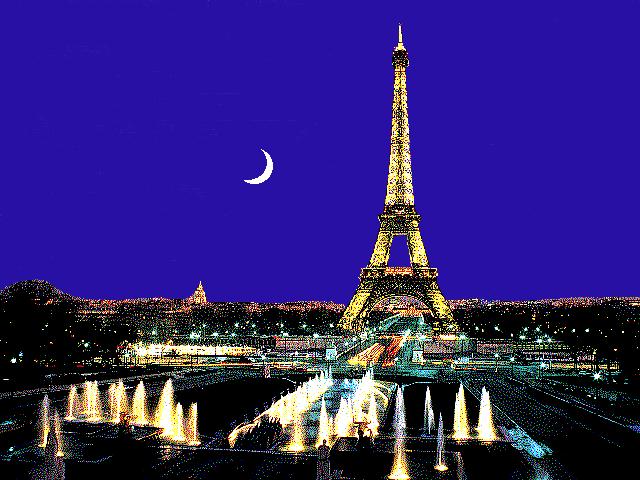
So, sorry, I cannot bring you any photos of the Eiffel Tower with fireworks. We could however from far see the special sparkling lightning of the Tower, which now is offered for five minutes every hour, after dark.

I thought I should quickly bring you these photos with a repeated wish for a HAPPY NEW YEAR!
You can fin the originals of these pictures on my photo blog.
This post requested some efforts. I did it before going late to bed... I think I will leave it here for two days, before making a new post!