Banana tree (follow up)
Labels :
Batignolles,
Paris 17,
Square des Batignolles
Since now four months I have reported on the banana tree in “my” park. It’s nicely growing, But still no bananas !

 The day before yesterday, I had the intention to take some pictures, but when I went out, I met this, so I decided to postpone.
 This is a little square, well hidden, but I happened to know about it as for some years I used to have my office quite close to here. It’s called “Cité de Trévise”. It’s very calm; a small green place in the middle, with a nice fountain (bad luck – no water), surrounded by some very nice buildings. It all dates from about 1840.
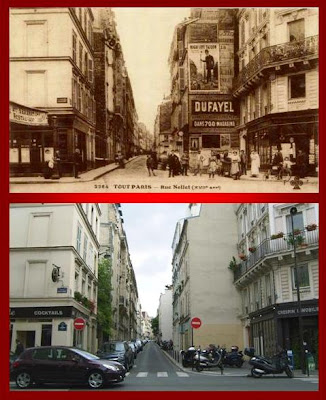
 You can reach the square from two long narrow stone paved streets. Alexandre Dumas lived on this one (first building to the right).

The houses in the area I live, “les Batignolles” Paris 17th arrondissement, were to large extent built during the latter part of the 19th century. Few houses are older or younger.
I have in earlier posts talked about some famous painters, poets, composers who used to live here, but most of the original inhabitants belonged probably to those days’ ordinary middle-class.
Built more or less during the same period, the buildings are often very similar in style, but there are some minor decoration differences, including the doors and the doorways. I have already made a post on “doors” and here is one on “doorways”, or rather what you can find just on top of the actual doorways; a bit more of fantasy than today.
I found the “hands” that you can see on the top picture slightly outside my area (but still close) and this is what gave me the idea to more closely look for other decorations.
This is not a collection of the nicest ones in Paris; it’s just pictured as I walked along the streets close to where I live (and my house is included.) I would certainly find something much more decorative if I went to the most fashionable areas.
 That flats were equipped with gas and electricity was something new and sometimes you can see small plates indicating that those commodities are available, like some of the older cafés advise that they have the telephone.


 If you climb the stairs around the “waterfall”, you will find a number of about 2 meter (6 or 7 ft) high statues, aligned more or less as the “moai” of the Easter Island. To gain space, I put them closer together in the below patchworks.

If you have some time over, I could suggest that you have a more detailed look on my photo blog.

 If from the Bastille you walk eastwards along the Seine (here open for walking, biking and roller skating), you will reach the Bercy area. Once you have passed
 This was still in the 70’s a large area of wineries with paved lanes and rails connecting with the riverside. I remember having then made a few more or less professional visits here. During the 90’s the whole area has been transformed into a large park. Some old trees, paved lanes and buildings have been preserved.


 In the extreme east of the garden there is a “village”, where some of the wine merchant buildings have been saved and transformed into shops, cafés and restaurants. You have here again direct access to a large cinema centre and to Paris’ most recent metro line (station Cour St.Emilion). Around the park there are some newly built apartment houses with a nice view.

 If you deviate a little from the normal tourist promenade of Montmartre, slightly downhill, you can find the small “Museum of the Romantics”. You have more or less to know the address (16 rue Chaptal), because it’s just an ordinary street, with some typical 19th century houses and then there is a small opening between two houses. If you walk up the little alley, you will suddenly come to a paved courtyard and you will see something which looks like a small manor house, more typical for the country side than for the centre of Paris.



 In my previous posts about « Around Place de la Bastille » you could see the new Paris opera house, Opéra Bastille, which was opened in 1989. The “real” opera house, the one we know since some 130 years, is now called “Opéra Garnier” and today mostly used for ballets. Both belong to Opéra National de Paris.
 Already from outside I had a problem; there is some reconstruction work ongoing and it’s today impossible to get a total “clean” front view. I had to “steal” this one from Wikipedia. My second amateur problem was to get some reasonably good quality pictures from inside (obscurity, bright lamps…), but I did my best.


 It was more particularly intended to be part of a canal system, making the connection between the Seine (there is a lock) and Canal Saint Martin, ready in 1825, partly rebuilt and covered between 1860 and 1906 and again recently modified (I may revert to this canal with another post – one day). Today the canal is covered about half way (dotted line); it's a tunnel, but the rest of it is very nice to visit - or travel on.

 Where you today can find the new Paris opera house, Opéra Bastille, used to be a railway station, Gare de la Bastille, for trains heading east, the Strasbourg line. The last – steam engined - train left the station in 1969 and it was demolished in 1984.
 Where there used to be rails, there is now a green, park like, promenade, some 4,5 km (3 miles) eastwards. At the end you reach the green area Bois de Vincennes. This creation has clearly created added value to the surrounding quarters (including the price for a flat).
 My granddaughter Paloma took the lead and the rest of the family had to follow.
 She got fascinated by all the flowers and decided to have a closer look at most of them and of course ask for their names. (She did not learn very much due to lack of knowledge of her promenade partners.)
  Anyhow, we had a nice walk. To go back home, I took a municipal bike.







 |
| Search by city: |


