Jardin du Ranelagh (3)
Labels :
Family,
Jardin du Ranelagh,
La Muette,
Musée Marmottan,
OECD,
Paloma,
Paris 16

This is the last “chapter” referring to the Jardin du Ranelagh and La Muette. (It will be a bit long, but I wished to finish.)
I already mentioned that what remained of the old royal castle was destroyed in the beginning of the 20th century. The heirs (the family Franqueville) sold the land in different parcels and the area became full of bourgois apartment buildings and also, facing the park, a number of private residences. Some of these residences – “hotels particuliers” - are still occupied as private homes, some as embassy residences. This is one of the most expensive areas of Paris.

 On part of what was sold from the old castle area, Henri de Rothschild, built a new castle, a new Château de La Muette, ready in 1922. Rothschild was an active person in many fields; he financed Pierre and Marie Curie, also wrote plays and novels under the name of André Pascal and gave a lot of elegant dinners and receptions here, until he was forced to move out due to the beginning of World War II. In 1940 the building became the headquarters for the German Naval Command and in 1945 the headquarters of the Allied Powers. In 1948 Rothschild sold the property to OEEC which originally was created to administer the Marshall Plan and later became OECD (Organisation for Economic Co-operation and Development) which still resides here. Thirty countries which are supposed to accept democracy and a free market economy are represented by delegations led by an ambassador. Important renovation work of the castle has been ongoing the last years, including also annexes (for a staff of about 2500).
 Some of the buildings are older and were already neighbours to the royal garden. One of them, later owned by the family Marmottan, was in 1932 donated to the French State and became a museum, Le Musée Marmottan. . Different donations by e.g. the heirs of a major sponsor of the impressionists (their doctor) and by one of Claude Monet’s sons have contributed to make this museum to the world’s richest in Monet paintings.
 It’s also here that you will find the perhaps most famous one, the one that gave the name to the impressionist movement, “Impression Soleil Levant”. (See my post mentioning the first impressionist exhibition - Grands Boulevards 3). You can also find a large number of works by Manet, Morisot, Renoir, Sisley, Degas, Pissarro… .
  The museum which too often is neglected has also one of the world’s most outstanding collections of illuminated manuscripts from the 12th to the 16th centuries as well a great collection of furniture, statues and paintings from the Napoleonic period.
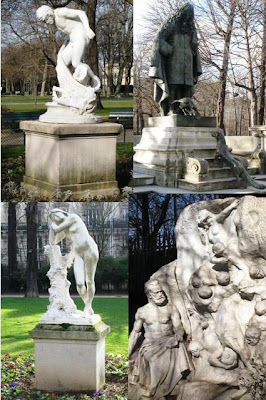
Together with Paloma, I passed by the park again yesterday. The weather was much warmer than during my previous visit and a lot more kids were playing. A few of the pictures used in the three posts about the Jardin du Ranelagh can be found on my photo blog.
I already mentioned that what remained of the old royal castle was destroyed in the beginning of the 20th century. The heirs (the family Franqueville) sold the land in different parcels and the area became full of bourgois apartment buildings and also, facing the park, a number of private residences. Some of these residences – “hotels particuliers” - are still occupied as private homes, some as embassy residences. This is one of the most expensive areas of Paris.
 On part of what was sold from the old castle area, Henri de Rothschild, built a new castle, a new Château de La Muette, ready in 1922. Rothschild was an active person in many fields; he financed Pierre and Marie Curie, also wrote plays and novels under the name of André Pascal and gave a lot of elegant dinners and receptions here, until he was forced to move out due to the beginning of World War II. In 1940 the building became the headquarters for the German Naval Command and in 1945 the headquarters of the Allied Powers. In 1948 Rothschild sold the property to OEEC which originally was created to administer the Marshall Plan and later became OECD (Organisation for Economic Co-operation and Development) which still resides here. Thirty countries which are supposed to accept democracy and a free market economy are represented by delegations led by an ambassador. Important renovation work of the castle has been ongoing the last years, including also annexes (for a staff of about 2500).
 Some of the buildings are older and were already neighbours to the royal garden. One of them, later owned by the family Marmottan, was in 1932 donated to the French State and became a museum, Le Musée Marmottan. . Different donations by e.g. the heirs of a major sponsor of the impressionists (their doctor) and by one of Claude Monet’s sons have contributed to make this museum to the world’s richest in Monet paintings.
 It’s also here that you will find the perhaps most famous one, the one that gave the name to the impressionist movement, “Impression Soleil Levant”. (See my post mentioning the first impressionist exhibition - Grands Boulevards 3). You can also find a large number of works by Manet, Morisot, Renoir, Sisley, Degas, Pissarro… . The museum which too often is neglected has also one of the world’s most outstanding collections of illuminated manuscripts from the 12th to the 16th centuries as well a great collection of furniture, statues and paintings from the Napoleonic period.
Together with Paloma, I passed by the park again yesterday. The weather was much warmer than during my previous visit and a lot more kids were playing.
A few of the pictures used in the three posts about the Jardin du Ranelagh can be found on my photo blog.


 There will be a third and last post on this park on Monday. In the meantime, I wish you a nice weekend!